The MCP Protocol Is the Most Important Standard Nobody Is Talking About
Anthropic's Model Context Protocol is quietly becoming the connective tissue of the agentic internet.
If you've spent any time reading AI news lately, you've probably heard people call the Model Context Protocol (MCP) the "HTTP of AI."
On face value, it looks like a slick analogy, but let's be honest: it's a bit lazy.
Do a quick Google search, and most top articles do a solid job covering the absolute basics and nailing them. The usual stuff: Anthropic introduced MCP, it uses JSON-RPC 2.0, and it works as a bridge between tools, databases, and APIs without custom code. All of this is accurate, and credit where it's due: the top articles on MCP are great primers.
But here's what those high-level summaries aren't telling you: we are building an agentic nightmare behind the scenes.
What is Model Context Protocol (MCP)?
The Model Context Protocol (MCP) is an open standard that acts as a universal adapter for AI applications and data sources. Think of this as the USB-C of how AI models, agents, and IDEs securely discover and interact with external data sources, enterprise tools, and local file systems without requiring custom API integration code for every pairing.
Why is Agentic AI adopting MCP over traditional REST APIs?
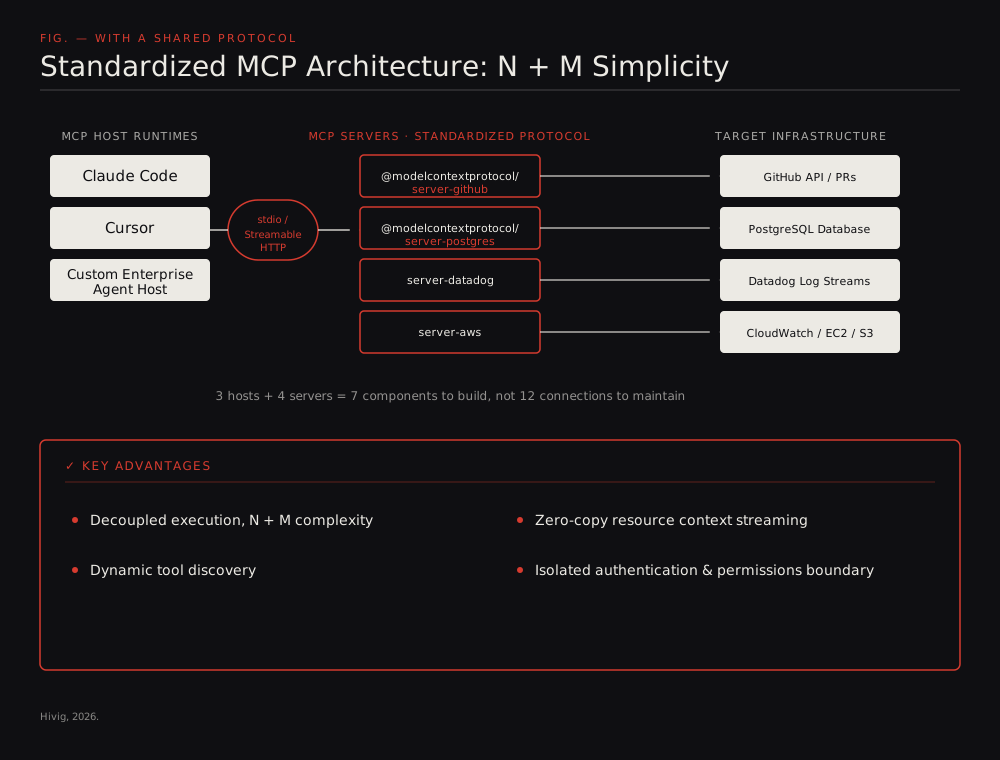
Because traditional REST APIs require custom function definitions and glue code for every model-and-tool pairing, creating unsustainable N × M integration overhead. Agentic AI MCP decouples the model runtime from tool execution, reducing complexity to N + M. Build an MCP server once for a tool such as GitHub, Postgres, or Jira, and any MCP-compliant AI client can dynamically discover and execute actions on it.
Why do I call it a nightmare in the making? Because custom integrations fail at enterprise scale. Here's why:
Right now, if you want your AI assistants to read a Postgres database, pull a ticket from Jira, check a log on Datadog, and push a pull request to GitHub, you have to write custom integration glue code for every model-tool pair.
So, if you have N AI assistants and M enterprise tools, you end up building and maintaining N × M custom integrations.
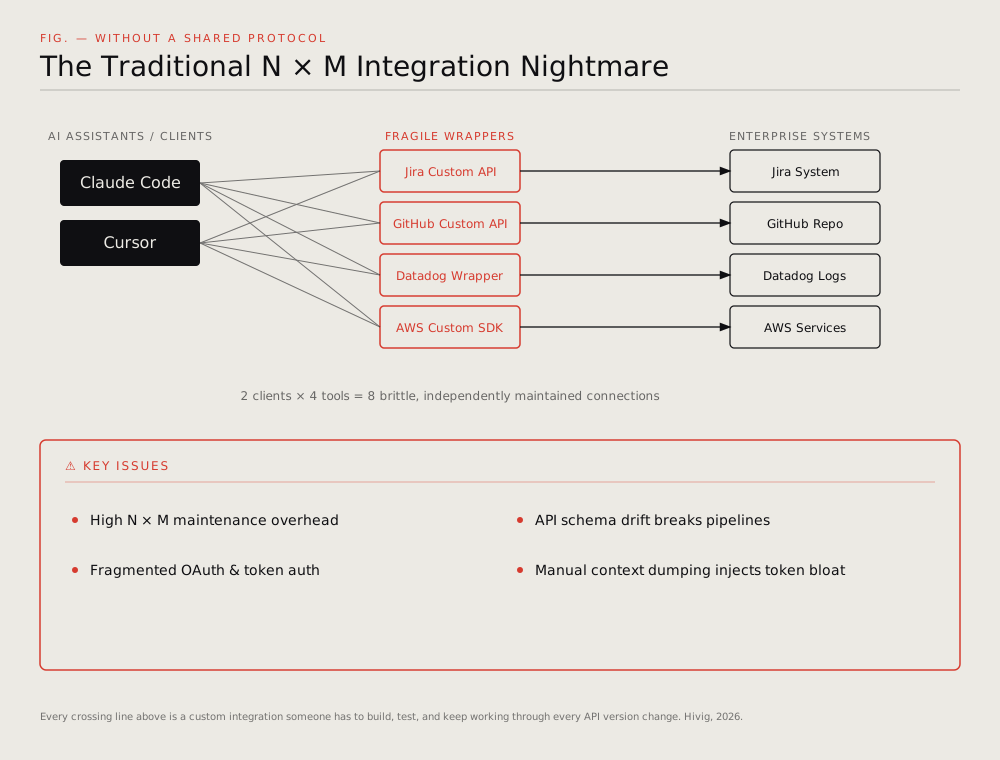
As Google Cloud's architecture documentation on tool integration notes, traditional point-to-point tool calling breaks down rapidly in production due to three main factors:
- Schema Drift & Fragility: Every time a vendor updates an API endpoint or a provider tweaks its tool-calling JSON schema, proprietary wrappers break unexpectedly.
- Maintenance Bloat: Teams spend more time updating authentication handshakes and debugging payload formats than writing actual business logic.
- Inconsistent Security Controls: Fragmented integrations make it nearly impossible to maintain central audit trails or enforce granular authorization across different LLM hosts.
This becomes more complex when the model platform, like OpenAI, tweaks its tool-calling JSON schema. Or, Anthropic updates Claude’s capabilities, and your glue code breaks. Your team spends more time maintaining REST wrappers and debugging authentication tokens than actually building intelligent agent logic.
[M + N]
How Does MCP Actually Work?
Model Context Protocol establishes a stateful, bidirectional JSON-RPC 2.0 connection that decouples the AI model runtime from external tool execution.
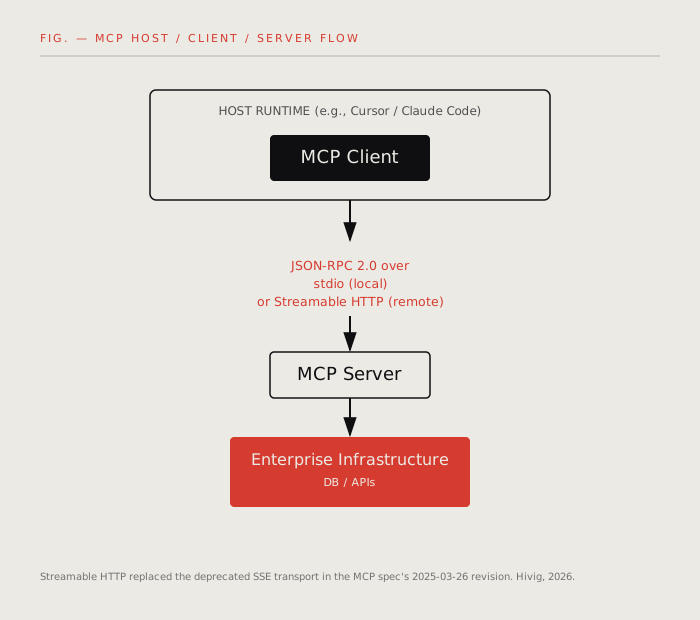
Instead of writing hardcoded API integration wrappers, an MCP host (like Cursor or Claude Code) connects to an MCP server that wraps a database, GitHub API, or local file system via a standard transport, either local stdio, or Streamable HTTP for cloud-hosted deployments.
During an initial handshake, the host dynamically discovers which Tools, Resources, and Prompts the server exposes, letting the agent execute actions and read live system state without modifying the core AI codebase.
The Three Structural Roles of MCP
Every MCP deployment relies on three distinct actors to manage execution boundaries:
- The MCP Host: The user-facing AI application or agent runtime (think Cursor, Claude Code, or a custom internal backend). It owns the LLM connection, drives the user interface, and initiates tool calls.
- The MCP Client: A protocol adapter living inside the host. It handles initialization handshakes, security scopes, and translates requests between the agent and external services.
- The MCP Server: A lightweight, focused service exposing actual system capabilities. One server might wrap a Postgres database, while another handles your internal GitHub API calls.
Beyond Generic Function Calling: The Three Primitives
Most internet discourse lumps everything around basic "function calling." MCP explicitly splits server capabilities into three distinct primitives, giving engineers far tighter control over state and execution:
- Tools: Model-controlled. Executable functions with explicit JSON schemas that trigger side effects. The LLM decides when to execute them, like running a SQL write query or opening a pull request.
- Resources: Application-controlled, passive data feeds designed for direct context injection. Represented by unique URIs, like file:///var/logs/app.log or postgres://schema/users.
- Prompts: User-controlled. Reusable system prompt templates stored on the server side, used to standardize complex, multi-step agentic workflows across the enterprise.
The Transport Layer: Zero Latency vs. Cloud Scale
When it comes to clients and servers passing messages back and forth, MCP uses two transport choices depending on where the server lives:
Transport Method | Ideal Environment | Key Technical Advantage |
|---|---|---|
stdio (Standard Input/Output) | Local IDEs & Desktop Agents (Cursor, Claude Desktop) | Zero network overhead and process-level isolation on local hardware. |
Streamable HTTP | Cloud Infrastructure & Remote Microservices | Real-time bi-directional streaming that hooks directly into enterprise OAuth setups. |
- Stdio: The host launches the MCP server as a local subprocess, exchanging raw stdin and stdout messages. Runs isolated on the user's machine with zero network latency.
- Streamable HTTP: For remote cloud servers, the client and server exchange messages over a single HTTP endpoint that upgrades to a stream only when a response needs one. This replaced the older two-endpoint SSE design because SSE had no way to resume a dropped connection.
The Real Game-Changer: Dynamic Discovery & Live Subscriptions
When an MCP client connects to a server, it doesn't rely on static, hardcoded API specs. It runs an initialization handshake:
- Capability Negotiation: The client queries the server to ask what tools, resources, and prompts it supports.
- Dynamic Schema Registration: The server returns its active schemas (like ListTools or ListResource).
- Live State Subscription: If underlying data changes, the MCP server pushes a real-time notification back to the host.
This dynamic discovery is why it's recognized as the foundation for true agentic scale. Instead of rewriting your agent's core codebase or updating prompt templates every time you add an enterprise tool, you simply spin up a new MCP server, and the agent discovers those capabilities instantly at runtime.
What MCP Means for Your Engineering Stack
In plain English, MCP is finally allowing a way to separate the intelligence layer from the integration layer.
Before MCP, if you wanted an AI model to interact with your company's internal tools, you had to treat the model like a hyper-fragile developer, hardcoding custom endpoints, writing manual function-calling schemas, and constantly patching integration glue code every time an API or model version changed.
MCP changes the architectural rules:
- For software architects: You build an MCP server for a tool once — for instance your Postgres database or Jira setup. This server becomes an instantly pluggable capability for any compliant AI agent, be it Cursor in your IDE, Claude Code in your terminal, or a custom internal orchestration service.
- For Engineering Teams: You stop spending hundreds of hours writing and maintaining proprietary REST wrappers. When a vendor updates an API or an LLM provider changes its payload format, the client-server handshake handles capability discovery automatically without breaking your agent logic.
- For Product Leaders: MCP substantially reduces vendor lock-in. Because the connection protocol is standardized under the Linux Foundation's Agentic AI Foundation, switching your underlying LLM provider doesn't require rebuilding your entire enterprise tool infrastructure — though real production friction still exists around session handling at scale.
Search Google, and you'll find that most articles leave you with an image of MCP as some sort of magical black box that connects LLMs to APIs. But an AI engineer shouldn't fixate on marketing buzzwords. If you're building agents, you just want to see the JSON payloads and how state is handled under load.
Are There Any Real-World MCP Case Studies?
This enterprise DevOps agent case study shows why Model Context Protocol matters. Here's what happens when an engineering team attempts to build a DevOps AI agent across four foundational tools: Jira, GitHub, Datadog, and Amazon Web Services (AWS).
The Before MCP Reality: Fragile Glue Code and Token Bloat
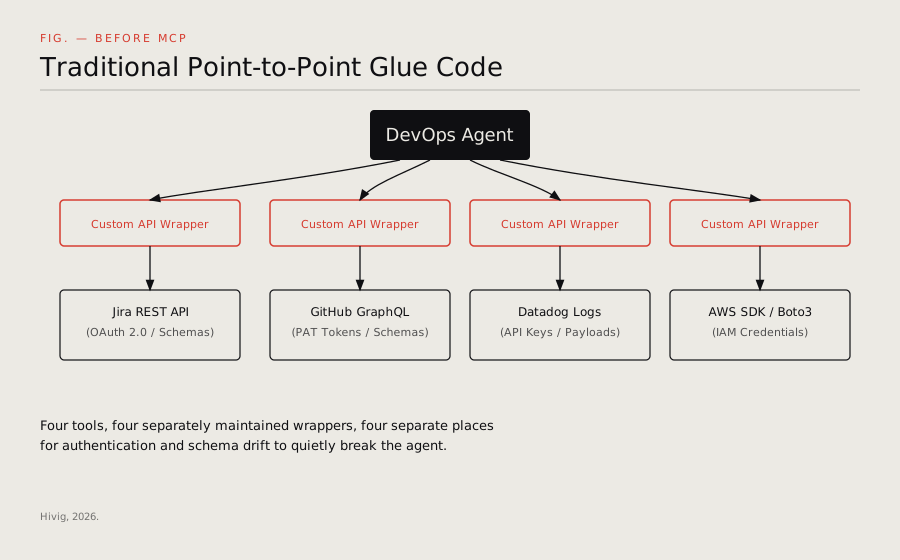
In a custom-coded agent setup, connecting these four platforms forces engineering teams to write and maintain four distinct API wrapper services:
- Authentication Silos: Managing long-lived personal access tokens (PATs), OAuth 2.0 handshakes, and AWS IAM role assumed-session credentials separately for each service.
- Schema Maintenance & API Drift: If GitHub updates its REST endpoints or Jira modifies its custom issue fields, the agent’s hand-coded JSON tool definitions break, causing downstream tool-execution failures.
- Context Inflation: To give the model context about an incident, the agent must fetch raw text logs from Datadog and dump thousands of lines directly into the prompt context window—spiking token consumption costs and slowing down inference response times.
The With MCP Reality: Dynamic Discovery and Zero-Copy Resources
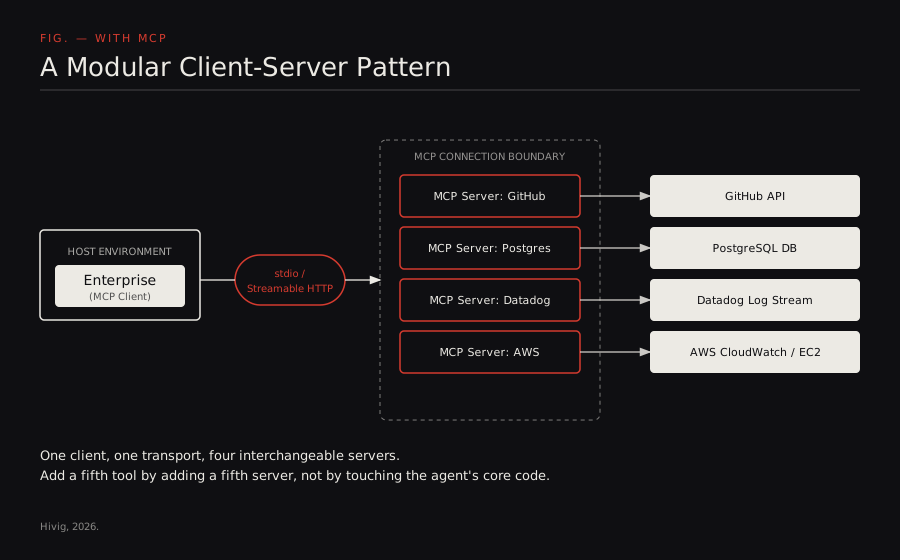
When implemented using MCP, the architecture shifts to a modular, client-server pattern using official, ready-to-use servers, like the @modelcontextprotocol/server-github and @modelcontextprotocol/server-postgres
- Dynamic Tool Discovery via ListTools: Instead of hardcoding tools into the LLM system prompt, the agent issues a standard ListTools request to all connected MCP servers at startup. The agent dynamically discovers available actions (e.g., github.create_pull_request or jira.transition_issue) without the core orchestrator knowing the implementation details.
- Zero-Copy Context Injection via Resources: Instead of shoving a 50MB log file into the LLM's active prompt window, the agent accesses log files via an MCP Resource URI (e.g., datadog://logs/incidents/10492). The MCP host streams or slices the exact context required without blowing up the agent's intermediate loops or token budgets.
- Isolated Authorization Boundaries: Authentication lives entirely on the individual MCP server side. The central LLM agent executes commands through the protocol without directly handling underlying API secrets, private keys, or infrastructure credentials.
How Does MCP Compare to RAG and Custom Function Calling?
A common question among enterprise software architects is whether MCP replaces existing AI patterns like Retrieval-Augmented Generation (RAG) or standard vendor function calling.
The answer is no: MCP does not replace RAG; it replaces the fragile glue code connecting models to external systems.
The comparative breakdown below highlights the key differences across architecture, execution flow, context handling, developer effort, and enterprise use cases:
Technical Comparison Matrix: MCP vs. Custom Function Calling vs. Traditional RAG
Feature / Metric | Model Context Protocol (MCP) | Custom Function Calling / Tool Use | Traditional RAG (Retrieval-Augmented Generation) |
|---|---|---|---|
Integration Architecture | Open Client-Server Protocol (JSON-RPC 2.0 over stdio / Streamable HTTP) | Model-specific / vendor-locked API schemas (OpenAI JSON specs) | Vector Database + Chunking & Embedding Pipelines |
Communication Flow | Bi-directional read & write execution (Actions + Context) | Model-dependent tool-execution loop | One-way passive data retrieval (Read-only) |
Context Refresh Rate | Live system state sync & real-time resource streaming | Static payload passed during prompt execution | Periodic batch embedding re-indexing |
Developer Effort | Build/deploy server once; reuse across any MCP host | Write and maintain custom glue code per model/API pair | Pipeline engineering (vector stores, chunking, embeddings) |
Primary Use Case | Autonomous agentic workflows, multi-tool execution, IDE tools | Simple single-purpose API triggers | Static enterprise knowledge retrieval & document Q&A |
Architectural Takeaways
- RAG vs. MCP: RAG is optimized for unstructured document search (e.g., searching 500 PDFs for policy compliance). MCP is built for live operational systems where an agent needs to inspect live data, execute commands, and track real-time state changes across multiple services.
- Custom Tool Calling vs. MCP: Custom function calling binds your code directly to an individual model provider's proprietary format. MCP creates a vendor-neutral boundary—allowing you to swap your underlying model provider without touching your database connectors, internal tool bridges, or infrastructure code.
The Governance & Security Blind Spots Nobody Is Discussing
While protocol standardization simplifies integration mechanics, exposing native execution contexts to autonomous LLMs opens critical enterprise risk surfaces. Moving MCP into production shifts security from basic API token checks to active agentic execution runtime protection.
Tool Abuse & Prompt Injection Risks
Exposing raw system execution through MCP servers fundamentally changes the threat model for enterprise systems. When an LLM interprets unstructured context and dynamically triggers tools via standard protocols such as stdio or Streamable HTTP, prompt injection shifts from a data leakage concern to an arbitrary tool execution risk.
- Unsanitized Schema Passing: If tool arguments generated by the agent pass directly to lower-level runtime drivers, malformed strings can lead to secondary command injections.
- Tool Shadowing & Over-Privilege: If an MCP server exposes overly broad execution methods (such as execute_query instead of scoped parameterized routines), an injected payload can trick the model into deleting records or exfiltrating data.
- Defensive Baseline: MCP server implementations must enforce deterministic, runtime-level input validation, explicit schema constraints, and parameterization before any tool invocation touches target infrastructure.
Granular Permission Controls
Default client implementations rely on basic confirmation prompts ("Allow once," "Always allow," or "Deny"). While adequate for desktop IDEs, this model fails in enterprise production environments where agents run autonomously in the background.
Authorization Metric | Default MCP Client Behavior | Enterprise-Grade RBAC Model |
|---|---|---|
Execution Scope | Binary allow/deny per session | Least-privilege role boundaries per user/agent identity |
Human Interventions | Desktop pop-up modal | Programmatic approval workflows (Slack, PagerDuty, Webhooks) |
Audit Logging | Local client logs | Immutable, centralized audit trails (SIEM, Datadog) |
Tool Scoping | All-or-nothing tool exposure | Column/Row-level security & field-level read/write masking |
Deploying MCP at scale requires decoupling authentication from individual client runtimes. Permission decisions must be enforced by an intermediate gateway or identity proxy that validates user scopes, JWTs, and dynamic policy rules before routing requests to backend MCP servers.
Token Bloat & Context Management
- Schema Overhead: Every connected MCP server broadcasts its available tools, schemas, and parameter descriptions into the model's system prompt. Exposing dozens of servers can inject tens of thousands of tokens before processing any user query.
- Inference Latency & Cost: Unchecked schema loading increases token counts, driving up per-request API costs and time-to-first-token (TTFT) overhead.
- Model Confusion: Swamping context windows with hundreds of tools increases the likelihood of tool hallucination, wrong function selection, and execution loops.
The Code Execution Wrapper Solution: Advanced enterprise stacks address context overload by introducing wrappers for dynamic tool loading. Instead of stuffing every full JSON schema directly into the LLM system context, a lightweight code execution runtime exposes high-level directory functions, retrieving only the specific tool definitions required for the current task and executing routines in an isolated sandbox.
The Future Roadmap: Governance & Ecosystem
The Model Context Protocol has moved beyond a single-vendor experiment into an open industry standard for context and execution routing.
The Shift to the Agentic AI Foundation (AAIF)
To establish neutral vendor governance and prevent single-vendor control, stewardship of the MCP specification has transitioned under the Agentic AI Foundation (AAIF) within the Linux Foundation.
- Protocol Evolution: Core specification updates are driven by open community consensus rather than proprietary vendor agendas.
- Enterprise Stability: Standardized interfaces remain backwards-compatible, preventing unexpected breaking schema changes across enterprise pipelines.
- Interoperability Assurance: Cross-platform compliance suites help ensure a conforming MCP server works across compliant host runtimes.
Cross-Model & Ecosystem Adoption
- Model Providers: Major LLM providers, including Anthropic, OpenAI, and Google (Gemini/Vertex AI), support MCP tool resolution, letting developers switch underlying models without rewriting integration code.
- Developer Tools & IDEs: Development environments such as Cursor, Windsurf, and Claude Code feature native MCP client discovery.
- Enterprise Frameworks: Enterprise agent orchestration layers and SaaS stacks are adopting MCP to decouple tool connectivity from prompt construction.
Companion Standards: Agent Skills
While MCP solves system execution and data fetching ("how do I read from this database or invoke this API?"), complementary standards like Agent Skills focus on procedural memory and task execution rules ("what are the organizational steps, business logic, and constraints required to perform this task correctly?").
Agent Skills deliver packaged, task-specific instructions, prompt templates, and domain-specific heuristics dynamically into the agent's memory window. Combined with MCP's standardized runtime connectivity, enterprises can separate what an agent should do (Agent Skills) from how it interacts with underlying systems (MCP).
Summary Thesis
Model Context Protocol is not merely another API wrapper or developer convenience library. It represents the foundational interoperability layer for enterprise agentic AI. By replacing custom, fragile N × M integration pipelines with a standardized N + M execution layer, MCP provides the technical abstraction required to build scalable, production-ready, and secure autonomous agent systems.
Frequently Asked Questions
How does MCP differ from traditional REST APIs?
REST APIs require hardcoded client logic and explicit endpoint calls for every integration. MCP is built for autonomous, non-deterministic agents: it exposes tools, resources, and prompts through one standard interface, so an agent discovers and calls capabilities at runtime instead of you writing custom code for every downstream system.
Is Model Context Protocol limited to Anthropic models?
No. MCP was originally introduced by Anthropic, but it's now an open, vendor-agnostic specification governed under the Agentic AI Foundation within the Linux Foundation. Anthropic, OpenAI, and Google's Gemini/Vertex AI models all support it, as do developer tools like Cursor, Windsurf, and Claude Code.
Can I run MCP servers securely in a private cloud environment?
Yes. MCP servers are lightweight and deployable anywhere in your infrastructure, including private VPCs, Kubernetes clusters, on-premises data centers, or air-gapped environments. Use local stdio for isolated executions, or Streamable HTTP with TLS and OAuth for private cloud networks.
References
- Anthropic: Model Context Protocol Announcement (anthropic.com/news/model-context-protocol)
- Model Context Protocol: Official Specification (modelcontextprotocol.io)
- Linux Foundation: Agentic AI Foundation Announcement (confirm exact URL before publishing)
- Google Cloud: Architecture Guide for LLM Tool Integration (confirm exact URL and verify the three-factor framing above against this source's actual wording)